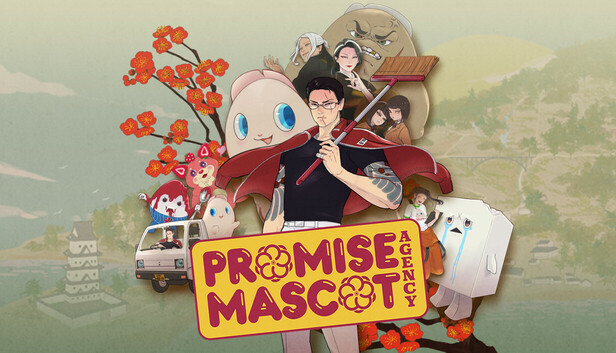
I went into Promise Mascot Agency with completely the wrong expectations. The trailers, especially those featuring a car drifting through town, gave me the impression that I might find something close to the tactile immediacy of Rocket League or the street-level swagger of Sleeping Dogs. What I found instead was something far stranger, slower, and undeniably more awkward. Yet that awkwardness quickly became part of the game’s identity, and eventually, one of its most endearing qualities.
This is an indie game that thrives on tonal dissonance. It constantly undermines your assumptions, not through shock value, but through a careful layering of systems and aesthetics that should not work together, yet somehow do.
An awkward vehicle with unexpected personality
The first thing that struck me was the car. Driving feels stiff, almost clumsy, as if the vehicle were slightly disconnected from the road. At first, I assumed this was a flaw, something that would fade into irritation over time. Instead, it became a kind of physical comedy. The car does not empower you; it humbles you. Every turn feels deliberate, sometimes hesitant, and the result is a strange but memorable relationship between player and machine.
Rather than offering mastery through precision, the game leans into imperfection. I stopped trying to drive “well” and started accepting the rhythm it imposed. That shift in mindset mirrors much of the experience: Promise Mascot Agency asks you to unlearn habits brought in from more conventional games.
Kawaii mascots and yakuza gore
Visually and thematically, the game makes a bold move by fusing two seemingly incompatible worlds. On one side, there is the soft, colorful, almost innocent design language of mascots that would not feel out of place in an Animal Crossing village. On the other, there is the unmistakable brutality and symbolism of yakuza culture.
The moment I realized that the main mascot is literally a severed pinky finger was a genuine shock. Not because it is graphically violent, but because of how casually the game presents it. For anyone familiar with yakuza traditions, the reference is obvious. The brilliance lies in how the game reframes that symbol into something cute, marketable, and strangely sympathetic. It sets the tone for everything that follows: a world where violence has been abstracted, commodified, and wrapped in a smiling costume.
Building a town through debt and routine
Structurally, the game owes a lot to life-sim design. There is a loan to repay, a town to improve, and a steady accumulation of small upgrades that gradually reshape your environment. This is where the Animal Crossing comparison becomes impossible to ignore. You return to familiar places again and again: the station, the bar, the convenience store, the town hall. Over time, these locations stop being simple waypoints and start to feel like lived-in spaces.
Unlocking new objects through different areas of the city is an intelligent way to encourage backtracking, even if the execution is not always elegant. The idea of “mysterious people” dropping useful items around town feels contrived. Even with the game’s end explanation, it never fully convinced me. It is one of those narrative shortcuts that I accepted mechanically but never emotionally. Still, the sense of growing familiarity with the town largely compensates for this awkwardness.
Repetition and economic pressure
Not everything holds up equally well. The rescue missions for mascots, in particular, suffer from repetitive text. After a while, I found myself mashing the A button just to get through dialogue I had essentially already read dozens of times. It is a small issue, but one that stands out in a game otherwise so attentive to tone and pacing.
What surprised me more was the difficulty curve. I expected to breeze through the early game on instinct alone, relying on years of gaming habits. Instead, I found myself under real financial pressure before even reaching the first third of the adventure. The economy becomes harder to read as the game opens up. You are constantly forced to choose between unlocking mascots, missions, locations, heroes, or investing time in side quests.
This lack of balance is not purely negative. Because the mechanics are so unusual, there is a genuine learning curve. Understanding how to make money efficiently requires observation and experimentation, not optimization guides or genre reflexes. Still, the late-game economy feels slightly less controlled than it should be (too easy), and some players may find that friction frustrating rather than stimulating.
A flawed but memorable identity
What ultimately stayed with me was not a specific mechanic or story beat, but a mood. Promise Mascot Agency is not polished in the traditional sense, nor does it aim for mechanical elegance. Its strength lies in its confidence to be strange, to mix tones that should clash, and to let discomfort and humor coexist.
I did not find what I expected, but I found something far more distinctive. It is a game that embraces awkwardness as a design principle, and in doing so, carves out an identity that is difficult to forget.
