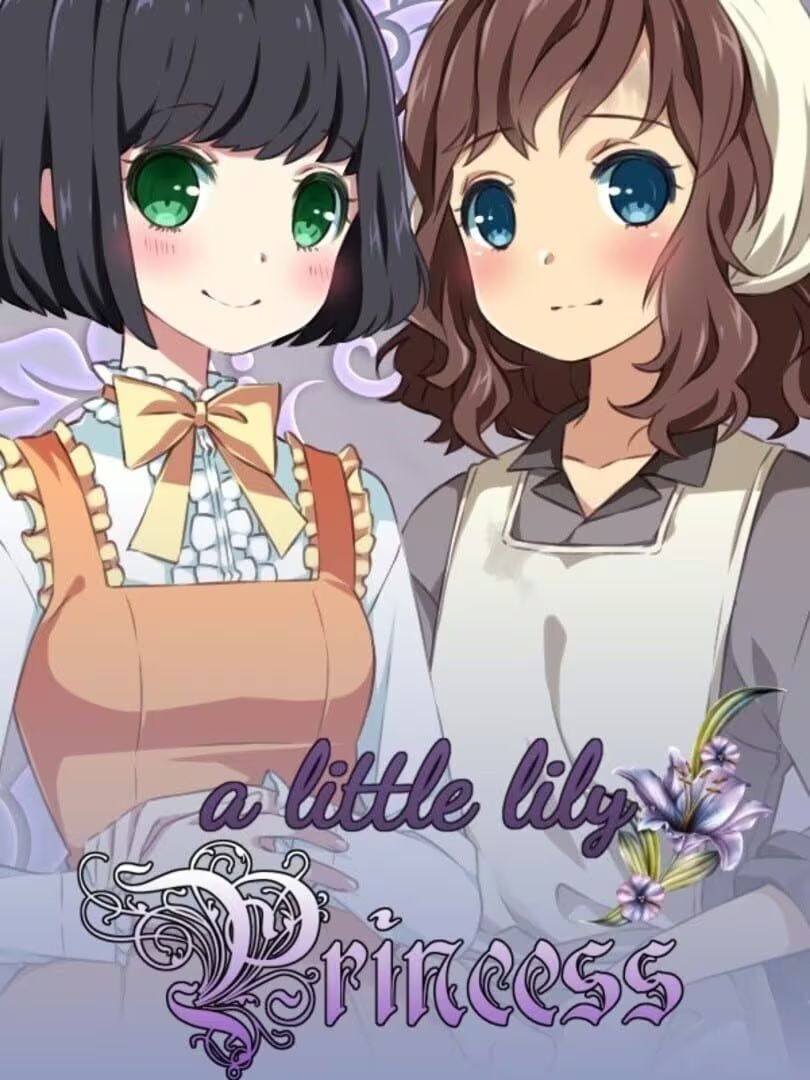
Kindred Spirits on the Roof Thumbnail

Kindred Spirits on the Roof similar games & best alternatives

Kindred Spirits on the Roof

PC (Microsoft Windows), Mac, Linux • 2016

Related articles

Quick resume

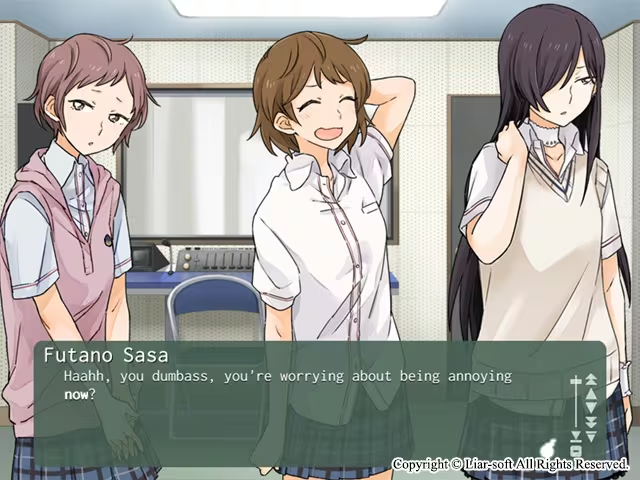
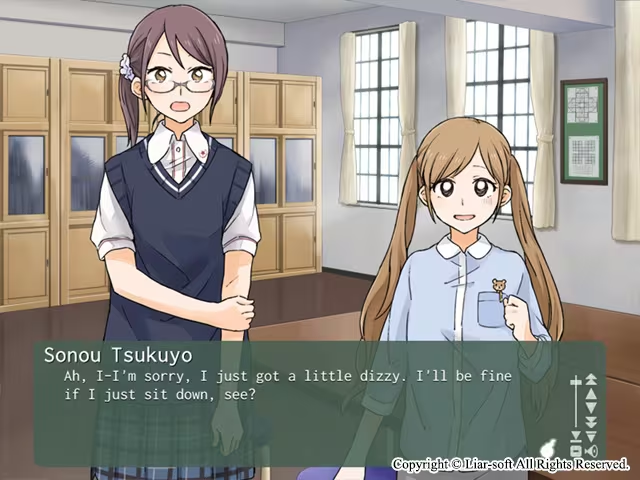
During lunch one day, Toomi Yuna meets two "Kindred Spirits" on the roof of her school. When they insist she help them nurture young love, Yuna finds herself playing "yuri cupid" to six unique and adorable couples. Can she remain aloof or will the promise of a "yuritopia" reach her too?

Global score

97/100

Genres

Adventure, Visual Novel, Simulator

Similar games

    Pros

    • Well-written emotional story
    • Deep character development
    • Multiple romantic couples
    • Tasteful adult content
    • Immersive voice acting and music

    Cons

    • High price point
    • Limited player choices
    • Low resolution graphics
    • Repetitive music tracks
    • Partial voice acting only

    Analysis

    Broadly representative of its motivational profile, with a few distinct shifts. Motivations that often define this kind of title include Strategy, Survival, Competence, Violence. Here, the score leans higher than usual among comparable games on Intimacy, Fellowship. It leans lower than usual among comparable games on Idle.

    How to use the graph
    Similar games map

    Each dot is a game. They are arranged from the same motivation profile as in the “Motivations” section below. Closer dots usually mean more similar reasons to play (exploration, competition, relaxation, etc.)—not that one game is “better” than another.

    • Larger dot with a light outline: the game you are viewing.
    • Colour: groups of games with comparable motivation patterns (statistical clusters).
    • Hover a dot to see the game name; click to open its page.
    • Scroll or double-click the chart to zoom out and see more games.

    Why don’t the axes read like a score? This view uses t-SNE: it only keeps who is close to whom. The scales are not “good to bad” or hours played—they separate groups on the map. Read distance between dots, not the axis numbers.

    Motivations

    • Autonomy
      3

      "Players follow a mostly linear story with limited choices that unlock extra scenes but do not affect main plot, indicating moderate player control over experience."

    • Competence
      -2

      "Gameplay is primarily reading and clicking through scenes with little skill challenge or variation."

    • Competition
      -5

      "No competitive elements or comparison to others; focus is on personal story experience."

    • Continuation
      4

      "Players report long playtimes, multiple replays to unlock extras, and strong attachment to characters and story."

    • Cooperation
      -5

      "Single player visual novel experience with no multiplayer or cooperative gameplay."

    • Creativity
      1

      "Some novelty in narrative structure and character perspectives, but mostly follows established visual novel conventions."

    • Domination
      -5

      "No elements of exerting control or superiority over others; interactions are narrative and equal."

    • Escapism
      5

      "Strong escapism through immersive emotional storytelling and fantasy elements like ghosts and romantic idealism."

    • Expectation
      -4

      "Players engage voluntarily out of personal interest and emotional connection, not obligation."

    • Experimenting
      -3

      "Limited player experimentation due to linear story and fixed outcomes; some exploration of different perspectives."

    • Exploration
      -4

      "Story unfolds in familiar school setting with no open world or discovery mechanics."

    • Expression
      -3

      "Some character customization in terms of story choices unlocking extras, but no avatar or environment personalization."

    • Fantasy
      4

      "Incorporates supernatural elements (ghosts) and idealized romantic fiction."

    • Fellowship
      2

      "Strong community feeling among fans and shared emotional experience, though gameplay is solo."

    • Growth
      4

      "Character development and emotional growth are central to the narrative experience."

    • Health
      -5

      "Sedentary gameplay typical of visual novels with no physical activity."

    • Idle
      -4

      "Requires focused reading and attention; not designed for idle or background play."

    • Intimacy
      5

      "Focus on forming deep emotional relationships and romantic intimacy between characters."

    • Leadership
      -5

      "No leadership or management roles; player is observer and facilitator in story."

    • Progression
      3

      "Progression through unlocking story scenes and extras, character relationship development."

    • Relaxation
      4

      "Generally relaxing and emotionally cathartic experience with gentle pacing."

    • Sensation
      2

      "Visual and auditory enjoyment from art and music, but sensory stimulation is moderate and not intense."

    • Status
      -4

      "Achievements and social recognition are minimal; focus is on personal narrative experience."

    • Story
      5

      "Strong narrative immersion with multiple perspectives and emotional plotlines."

    • Strategy
      -4

      "No strategic or problem-solving gameplay; story is linear with minor choices."

    • Thrill
      -3

      "Emotional tension and drama present but no suspense or risk-based thrills."

    • Value
      3

      "Players report high value for time spent due to length and emotional engagement."

    • Violence
      -5

      "No violence; focus on romance and emotional connection."

    • Survival
      -5

      "No survival or threat elements; stable and safe narrative environment."

    Last update: 29/04/2026